

It’s 9:47 p.m. on a school night, and 12-year-old Maya is still texting friends under her blanket when she should be asleep. Her parents didn’t set a rule about phone use after 9 p.m. — they just assumed she’d know better. This scene plays out in millions of American households every night, and it’s exactly why a family device agreement matters more than any parental control app you could install.
A family device agreement is a written, mutually discussed document that spells out how screens, phones, tablets, and gaming consoles are used in your home. It’s not a punishment list — it’s a shared understanding that removes daily arguments and gives kids clear expectations they helped create.
Why Verbal Rules Don’t Work
Consider the Rodriguez family in Austin, Texas. Their 10-year-old son Diego had an unspoken rule: no phone at the dinner table. But because it was never written down or discussed as a family, Diego’s older sister used her phone at dinner “just to check one thing,” and within weeks the rule had quietly dissolved. Verbal agreements fade because there’s no shared reference point — and no consequence structure everyone agreed to in advance.
Research from Common Sense Media found that 71% of parents report daily conflict over screen time, and the number one cause cited was “inconsistent rules.” A written agreement fixes that inconsistency by making the rule visible, specific, and co-created.
What Belongs in a Family Device Agreement
An effective agreement covers five concrete areas. Vague language like “use devices responsibly” doesn’t help a 9-year-old — specificity does.
- Time limits: Instead of “not too much screen time,” write “45 minutes of recreational screen time on school days, 2 hours on weekends,” similar to the limit the American Academy of Pediatrics recommends for children ages 6-12.
- Device-free zones: Name the actual rooms — “no phones in bedrooms after 8:30 p.m.” or “no tablets at the dinner table” — rather than saying “be mindful.”
- App and download approval: Specify that any new app requires a parent’s sign-off before installation, and list which apps are pre-approved (e.g., school apps, a family messaging app).
- Consequences for breaking the agreement: Define these in advance, like “first violation = 24 hours no phone, second violation = one week,” so enforcement isn’t an argument in the moment.
- Privacy and monitoring terms: Be transparent — if you’ll check messages or use a monitoring app like Bark or Google Family Link, say so in the agreement itself. Surprise monitoring erodes trust faster than any rule violation.
A Real Example: The Chen Family’s Agreement
The Chen family in San Jose, California, built a one-page agreement with their two kids, ages 8 and 13, after their older daughter Emily was found chatting with a stranger in a Roblox group chat. Their agreement included:
- No devices in bedrooms overnight — all phones charge in the kitchen from 8:30 p.m. to 7 a.m.
- Any online friend request from someone not known in person must be shown to a parent first.
- Screen time is capped at 1 hour on weekdays, tracked using Apple’s Screen Time feature.
- Breaking the “stranger contact” rule results in the account being paused for one week — not confiscation of the whole device, since the rule was specific to that behavior.
Six months later, Emily’s mother reported that arguments about phone use dropped from almost daily to about once a month, because both kids had helped write the rules and understood exactly why they existed.

How to Build the Agreement Together
The agreement works best when kids are part of drafting it, not just recipients of it. Try this three-step process:
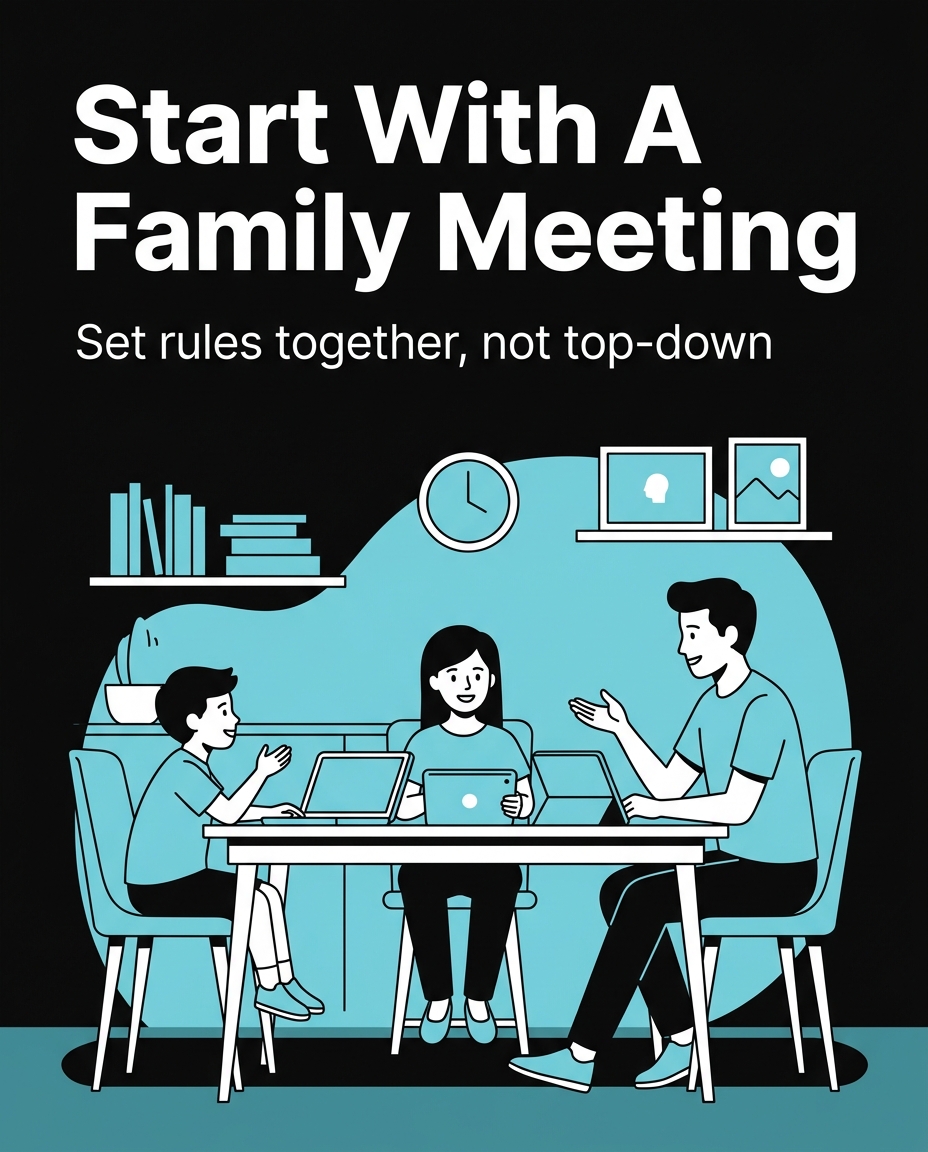
1. Hold a Family Meeting
Sit down together — no devices in the room — and ask your kids what they think is fair. A 14-year-old might negotiate for more time on weekends in exchange for stricter homework-hour limits. Letting them advocate for themselves increases buy-in dramatically.
2. Write It Down and Post It
Print the agreement and put it somewhere visible, like the refrigerator or a shared bulletin board. The Nguyen family in Chicago laminated theirs and hung it next to the charging station, so there was never a dispute about what was agreed.
3. Review It Every 3–6 Months
A rule that fits a 9-year-old won’t fit the same child at 12. Set a recurring calendar reminder to revisit the agreement as your kids grow, gain new apps, or get their first phone.
Common Mistakes Parents Make
Even well-intentioned families run into pitfalls:
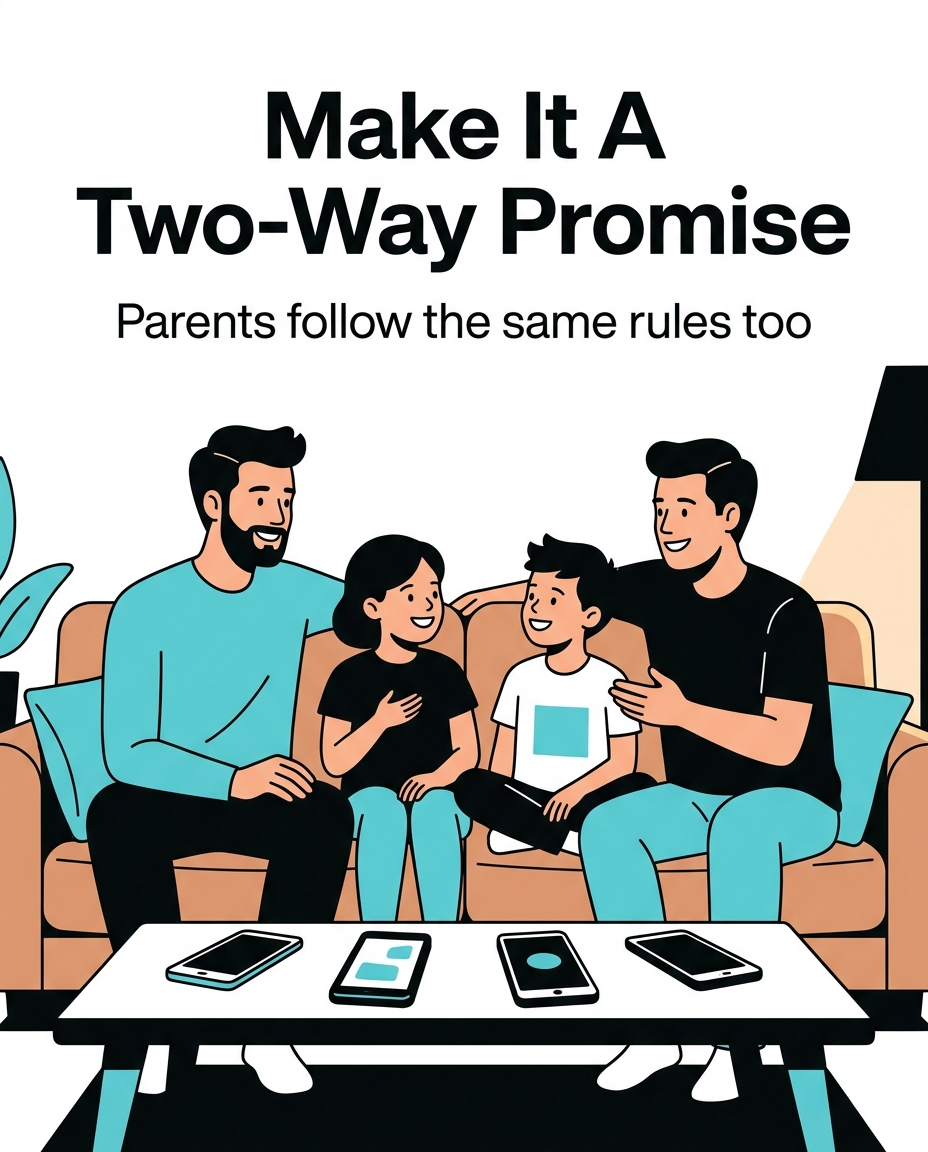
- Making rules only for kids. If Dad is on his phone at dinner but the rule says “no phones at the table,” kids notice the double standard immediately. Agreements work best when they apply to the whole family.
- No enforcement plan. A rule without a clear, pre-agreed consequence turns every violation into a fresh negotiation — and a fresh argument.
- Treating it as permanent. A 7-year-old’s agreement should look different by age 15. Static rules stop being effective and start being ignored.
- Skipping the “why.” Explaining that time limits protect sleep, or that stranger-contact rules protect against grooming risks, helps kids follow rules out of understanding rather than just obedience.
Sample Starter Template
If you’re building your first agreement this week, here’s a simple structure you can adapt:
- Screen time: ___ minutes/hours on school days; ___ on weekends
- Device-free zones/times: ___ (e.g., bedrooms after 8:30 p.m., dinner table)
- New apps/games: Must be approved by ___ before downloading
- Online contacts: Rule for accepting friend/follow requests from strangers
- Consequences: First violation ___; repeated violations ___
- Review date: ___ (set a date 3-6 months out)
A family device agreement isn’t about restricting your kids — it’s about giving everyone in the house, parents included, a shared, fair, and clearly understood standard. Families who write it down, build it together, and revisit it regularly see far fewer conflicts and far more trust around technology at home.
Want to try it out? 🚀
- 🎬 Sample lesson: Free trial
- 📋 Full syllabus: View the program
- 🎓 Enroll & details: Cyber School courses
The International Cyber School Program (Grades 4–9): live online, globally recognized certifications, from fundamentals to CTF.
Frequently Asked Questions
At what age should a family start using a device agreement?
Most experts recommend starting as soon as a child has regular access to any screen — often around age 5 or 6 for tablets, and definitely by the time a child gets their first phone, typically ages 10-12 in the US.
Should the agreement be the same for every child in the family?
No — while core rules (like device-free bedtime hours) can apply to everyone, time limits and app permissions should be adjusted by age and maturity, then clearly noted as different in the written agreement so it doesn’t feel unfair.
What should parents do if a child keeps breaking the agreement?
Revisit the agreement together rather than simply escalating punishment — repeated violations often mean the rule doesn’t fit the child’s current needs, or the consequence wasn’t clearly understood in advance.