Have you ever sent a text that said “lol” and gotten a reply in less than a second — even if your friend was 2,000 miles away in Texas while you were in California? That’s not magic. It’s a super-organized delivery system working faster than you can blink. Let’s break down how the internet sends your message, step by step, using real numbers and a real example.
Your Message Doesn’t Travel in One Piece
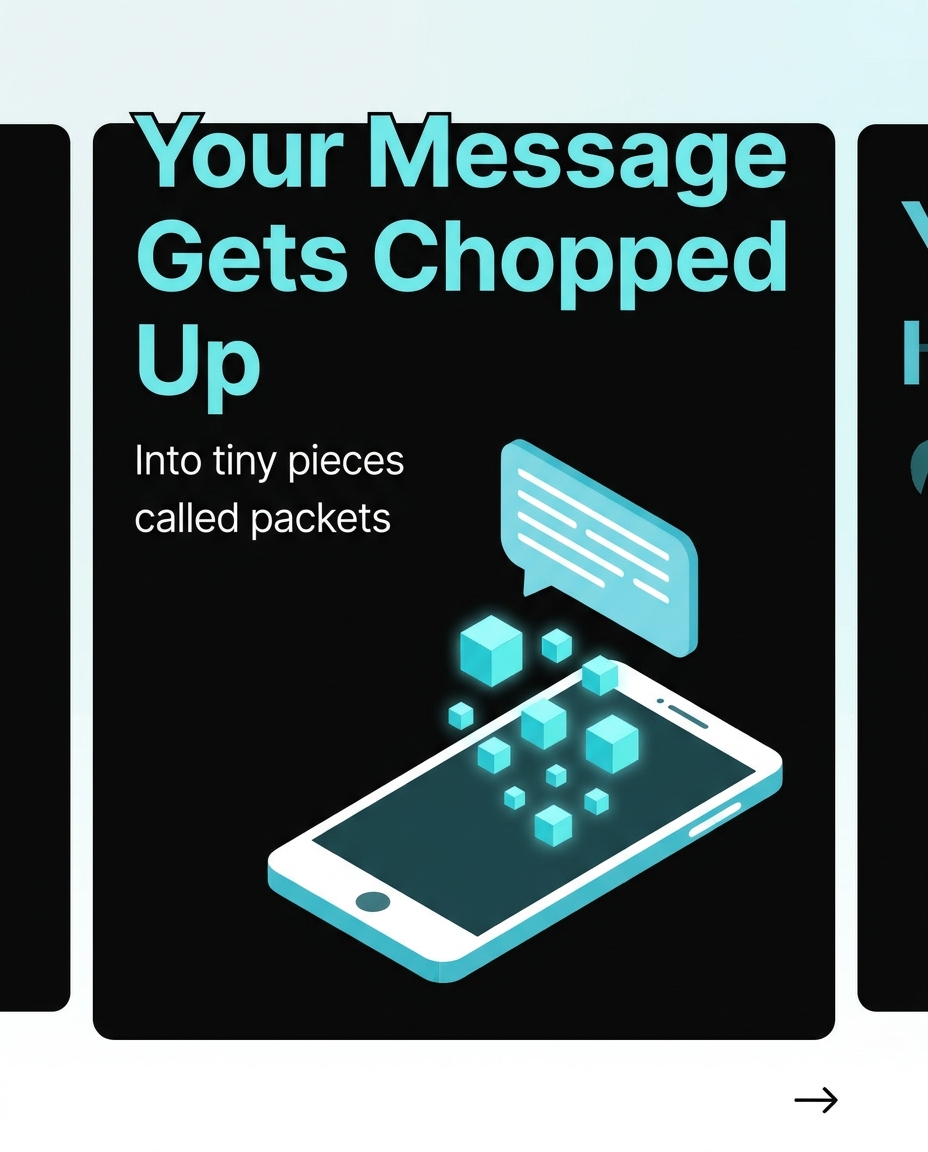
Here’s the part that surprises most kids: when you type “Want to play Minecraft after school?” and hit send, your phone doesn’t ship that sentence as one whole chunk. It chops it up into tiny pieces called packets. Each packet might only hold about 1,500 bytes of data — roughly the size of a short paragraph of text. A single photo you send on Snapchat, which might be 3 megabytes, could get broken into more than 2,000 packets before it ever leaves your phone.
Why break it up? Imagine trying to mail a giant 500-page book through a mail slot that’s only wide enough for one page at a time. You’d slide the pages through one by one, and the person on the other end would put them back in order. That’s exactly what packets do — except instead of a mail slot, they’re squeezing through cables and radio signals, and instead of taking minutes, it takes milliseconds.
Every Packet Gets Its Own Address Label
Each packet needs to know where it’s going, so it gets stamped with an IP address — a string of numbers like 172.217.14.206 (which, believe it or not, is one of Google’s real addresses). Think of it like the shipping label on an Amazon box: it doesn’t just say “California,” it says the exact street, city, and zip code.
Your home Wi-Fi router also has its own address, kind of like your house’s mailbox. When you send a message from your phone, your phone hands the packet to your router first. The router looks at the destination address and decides: “This isn’t for anyone in this house — it needs to go further.” Then it forwards it out to the wider internet.
Here’s a real example: in 2021, a study by Cloudflare (a company that helps run internet traffic) found that a typical webpage load involves your device talking to 15 to 20 different servers around the world — for ads, fonts, images, and scripts — all within about 2 seconds. Every single one of those connections uses this same address-and-packet system.
Routers: The Relay Race Team
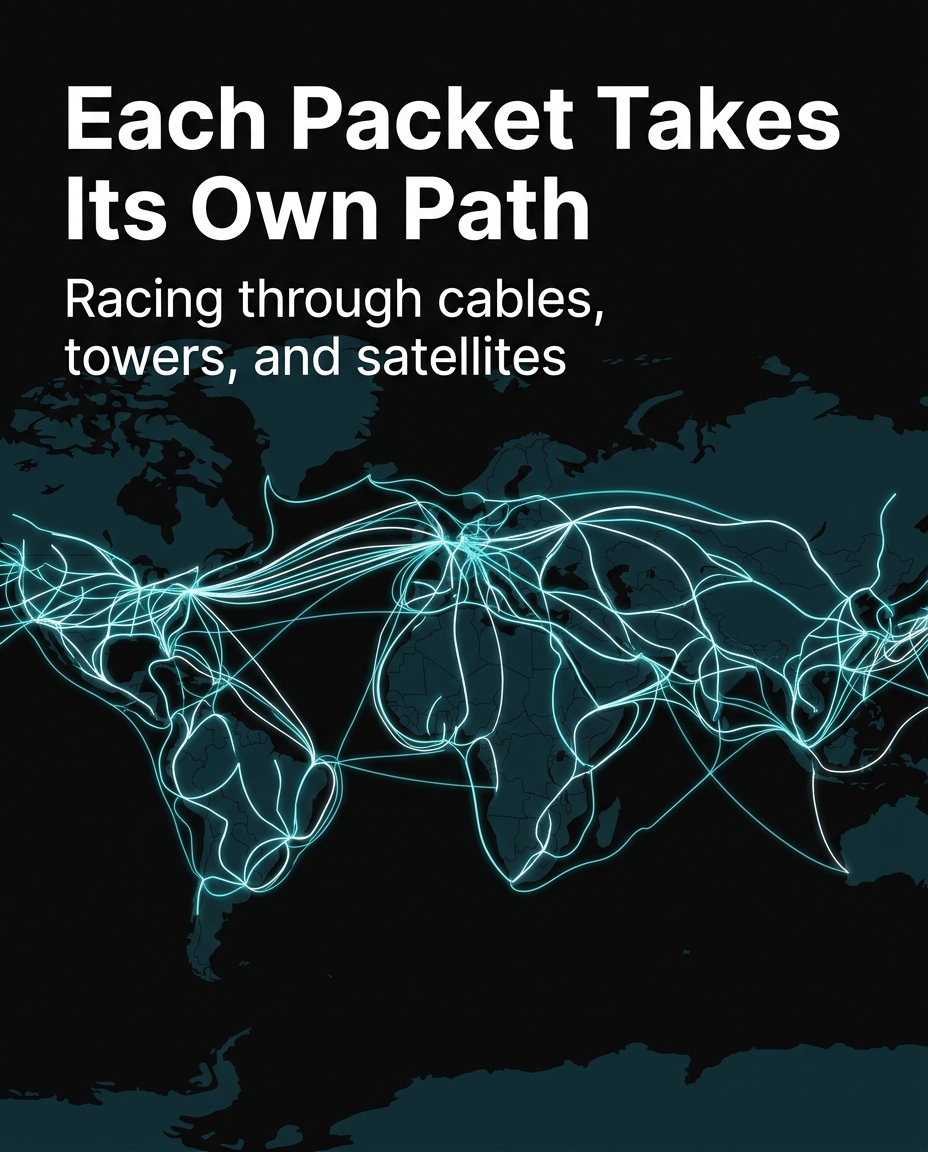
Once your packet leaves your house, it doesn’t go straight to its destination in one giant leap. It hops between machines called routers, kind of like a relay race where each runner passes the baton to the next. A message from a bedroom in Ohio to a friend’s phone in Japan might pass through 12 to 15 routers along the way — each one owned by a different company, in a different city, sometimes in a different country.
You can actually see this happen. There’s a tool called “traceroute” that engineers use, and when someone ran it from New York to Tokyo in a real test, the message bounced through cities including Chicago, Los Angeles, and then undersea to Japan — and the whole trip, including 13 hops, took about 140 milliseconds. That’s faster than the blink of an eye, which takes about 300–400 milliseconds.
Yes — Actual Cables Under the Ocean
This next part blows most kids’ minds: even though we call it “wireless” and “the cloud,” almost all long-distance internet traffic travels through physical cables — many of them lying on the ocean floor. As of 2023, there were more than 530 undersea cables crisscrossing the planet, some over 12,000 miles long, connecting continents. One cable, called MAREA, stretches from Virginia Beach to Bilbao, Spain, and can move 200 terabits of data per second — enough to stream about 71 million HD videos at the exact same time.
So when your Fortnite match connects you to a friend in another country, your game data might genuinely be traveling through a fiber-optic cable thinner than a garden hose, sitting at the bottom of the Atlantic Ocean.
Putting the Pieces Back Together
When all those packets finally arrive at your friend’s phone, they don’t always show up in the order they were sent. Because they might take slightly different paths (like cars taking different highway exits to avoid traffic), packet #47 might actually arrive before packet #12. That’s okay — every packet is labeled not just with an address, but with a sequence number, kind of like page numbers in a book. Your friend’s phone collects all the pieces, checks the numbers, puts them back in the correct order, and rebuilds your original message — all in a fraction of a second, without you ever noticing.
If a packet gets lost along the way (which does happen — engineers estimate about 1-2% of packets get dropped on an average connection), the system notices a missing piece and asks the sender to resend just that one packet, not the whole message. That’s why a video call sometimes freezes for a split second and then catches up — it’s quietly repairing itself in real time.
A Real-World Example: Sending One Text Message
Let’s trace an actual text: “See you at 3pm!” sent from an iPhone in Miami to an Android phone in Seattle.
- Your phone breaks the message into 1 small packet (it’s short) and attaches your friend’s IP address.
- It travels through your home Wi-Fi router, then to your internet provider’s larger routers.
- It hops through several regional routers — possibly through Atlanta, then Dallas, then Denver.
- It arrives at your friend’s internet provider, then their home router, then their phone.
- Total distance: about 2,700 miles. Total time: usually under 100 milliseconds.
That’s faster than the time it takes you to blink twice.
Why This Matters for Staying Safe Online
Understanding this journey isn’t just cool trivia — it helps you understand why online safety matters. Every packet you send has your device’s address attached to it, kind of like writing your return address on an envelope. That’s part of why programs like Cyber School USA teach kids to think about what they send: because messages really do travel through many machines and many networks before they arrive, and being thoughtful about what you share keeps that journey safer.
Want to try it out? 🚀
- 🎬 Sample lesson: Free trial
- 📋 Full syllabus: View the program
- 🎓 Enroll & details: Cyber School courses
The International Cyber School Program (Grades 4–9): live online, globally recognized certifications, from fundamentals to CTF.
Frequently Asked Questions
Does the internet really break my messages into pieces?
Yes — almost every message, photo, or video is split into small pieces called packets, sent separately, and reassembled by the receiving device in the correct order using sequence numbers.
How fast does a message actually travel across the world?
Very fast. A message can travel thousands of miles — even across oceans through undersea cables — in well under a second, often in just 100 to 200 milliseconds.
Is the internet actually cables, or is it wireless?
Both — your phone connects wirelessly to Wi-Fi or cell towers, but long-distance traffic almost always travels through physical fiber-optic cables, including more than 530 cables running under the ocean floor.